Back

BuddyHQ.AI

Your customers are already saying incredible things about your product. BuddyHQ turns that voice video, audio, text into branded, publish-ready UGC content. No editing suite. No copywriter. Just feedback in, marketing assets out.


BuddyHQ Logo
I'm Live!
Website Link
BuddyHQ hero

30-second overview

  • This is a 0→1 AI SaaS product called BuddyHQ, a content engine that turns raw customer feedback into branded, publish-ready marketing assets.
  • I led the end-to-end design of the MVP, from initial concept to production-ready specifications. Defining the conversational interface, the content pipeline, and a three-tier storage system.
  • Starting with SME interviews and a discovery sprint, I shaped the product strategy, designed scalable patterns like conversational generation and a global content library, and partnered with engineering across sprints to ship.
  • The work is built and pre-release. PoC validation with 5 marketing teams and internal stakeholder alignment unlocked the next phase of development.

Overview & Context

BuddyHQ is an AI platform that turns raw customer feedback into branded, publish-ready marketing content, without the toolchain.

PRODUCT
Web platform · SaaS application
SKILLS
UX strategy, product & interaction design, system architecture, design–dev collaboration
TIMELINE
Jan 2025 – May 2025 · 5 months
TEAM
Deepak (Led Designer), 1 Full-stack engineer, 1 PM, founder

Impact

Designed and shipped 6 core modules end-to-end, supporting 7+ content output formats from a single unified interface.
Defined the three-tier content architecture (Chat → Project → Library) the structural backbone the team continues to build on.
Validated the conversational-first model with 12 marketing professionals across SME interviews and PoC testing.
Pre-release product approved internally; stakeholder validation greenlit the next phase of partner-facing rollout.

Problem

Hours of customer voice. Zero content.

Imagine you're a marketing lead at a B2B SaaS company.

You just wrapped a customer interview series. 14 video calls, 200+ written survey responses, and three months of support transcripts sitting in a Google Drive folder.

Every one of those conversations has a quote, a moment, a story worth publishing. You know it. Your team knows it. But by Friday, you'll ship two LinkedIn posts and one case study draft. The rest will sit untouched until someone deletes the folder next quarter.

This is what most B2B marketing teams deal with every week.

The signal is there. The system to turn it into content isn't. Every piece of marketing content from customer feedback travels through 5+ handoffs across 4+ tools, manually, every single time:

1

Collect

Survey tools or video platforms drop raw responses into spreadsheets.

2

Review manually

A marketer watches hours of footage, highlights usable quotes. Most signal gets lost here.

3

Brief the team

Summaries get handed to copywriters and designers. Context is already diluted.

4

Build assets

Videos clipped in Premiere, posts in Canva, emails in another tool. Nothing shares context.

5

Scatter and lose

Final assets live across Drive, Notion, Dropbox. No source of truth.

3–7D
Average time
per content batch
4+
Tools involved
per asset
5+
Handoffs
before publish
~80%
Customer feedback
never used
My Note

At first, it looks like a content problem. It's actually a system problem. Teams aren't short on tools, they're operating across disconnected systems with no continuity between them.


Vision

BuddyHQ says: let me turn your customers' words into your best campaigns.

BuddyHQ was built on a simple idea:

What if customer voice didn't sit in folders, but flowed directly into the content marketing teams actually ship?

From a product perspective: BuddyHQ ingests customer feedback in any modality video, audio, text, surveys, transcripts. Runs it through an AI engine that handles transcription, theme extraction, and brand voice calibration, and returns 7+ branded content formats ready to publish. One pipeline. One interface. Zero tool switching.


My Role

I was the lead designer for this product.

As the first and only designer on the project, I owned the end-to-end design of BuddyHQ's MVP from early product definition to scalable delivery.

  • Partnered closely with the founder, PM, and engineering team to shape the product strategy, structure the user experience, and define what the MVP needed to prove.
  • Led SME interviews and discovery sessions with 12 marketing professionals to validate the conversational-first interaction model.
  • Designed and shipped 6 core modules end-to-end, supporting 7+ content output formats from a single unified interface.
  • Architected a three-tier content hierarchy (Chat → Project → Library) that became the structural backbone of the product.
  • Translated raw AI capability into conversational, intent-driven workflows that marketing professionals could use without training.
  • Collaborated with engineering across sprints in a continuous design–build loop, ensuring high-fidelity execution and technical feasibility.

Challenges

When I joined, there was no product. Just an AI engine.

The team had built a working AI pipeline that could ingest video, audio, and text and generate output in multiple formats. What they didn't have was a product around it. No interface. No information architecture. No defined user journey.

The AI was capable, but raw capability isn't a product. The challenge was figuring out:

  • Who would use this, and what specifically did they need it to do?
  • How do you design an interface for an AI that can produce 7+ types of content from a single input?
  • How do you hide the complexity of the AI engine while still giving users meaningful control?
  • Where does the content go after it's generated and how do teams reuse it?
My Note

The challenge wasn't a lack of capability. It was a lack of structure. I needed to design systems that surfaced what mattered, without exposing the machinery underneath.


Research & Discovery

So we started with a discovery sprint.

Before touching Figma, I ran a focused 5-day sprint to understand who BuddyHQ was actually for and how they'd use it. The goal was to validate the product hypothesis with real marketing teams before committing to a direction.

Discovery sprint plan

DAY 1
MAP

Stakeholder alignment, current workflow audit

DAY 2
INTERVIEWS

SME sessions with 12 marketing professionals

DAY 3
SKETCH

Concept exploration and information architecture

DAY 4
DECIDE

Synthesize findings, lock direction with team

DAY 5
VALIDATE

Test prototype concepts with 5 PoC users

SME interviews, what marketers actually said

I ran 12 sessions with content marketers, growth leads, and content managers across SaaS companies. The conversations were more specific than I expected. Three breakdowns came up in every session:

  • Fragmented tools → broken workflows. “It's not that any one tool is bad. It's that nothing talks to anything else.”
  • Context loss → degraded content quality. “By the time the post is written, it doesn't sound like the customer at all.”
  • No reuse layer → lost compounding value. “We made a great asset last quarter. I have no idea where it is now.”

The personas that shaped our design

Vishwa Venkatesan
Marketing Lead, B2B Saas

I have hours of customer interviews. I just want someone to hand me a finished LinkedIn post that sounds like the customer actually said it.

Arun Kumar
Content Creator, Solo

I'm a team of one shipping across five channels. I need leverage, not another tool to learn.


Delivering the Proof of Concept

After the discovery sprint, we shipped a clickable PoC.

The PoC validated the conversational-first model with real users and gave the team a concrete artifact to align on. I designed and prototyped the core interaction loop: upload feedback → describe intent → review generated content.

PoC validation results

I tested the prototype with 5 marketing teams from the SME pool. The findings unblocked the next phase:

5/5
Teams completed
core task unaided
~45s
Avg time
to first output
4.6/5
Would use
this tomorrow
0
Required
onboarding steps

⚠ Disclaimer: Early validation signals from a controlled PoC (n=5). Metrics indicate directional usability and adoption potential, not production-scale outcomes.


Defining the MVP

From PoC to scalable modules.

The PoC validated the concept. The real challenge was figuring out: which modules should we build first, and how could they flex across content formats without fragmenting into five separate products?

From the SME interviews and PoC sessions, the priority was clear:

  • Marketing leads wanted quick generation from a single source minimum effort, maximum output.
  • Content managers wanted flexibility across formats - video, post, email, blog, audio without learning five interfaces.
  • Both groups wanted reuse. “I want to find that asset I made last quarter without searching three tools.”

That shaped the MVP into 6 core modules, each reusing the same generation engine, the same component patterns, and the same content storage system.

Strategic decision

The modules aren't five products. They're five views into the same engine. One source of truth, multiple surfaces. This was the architectural choice that made BuddyHQ scalable.


Core Feature #1

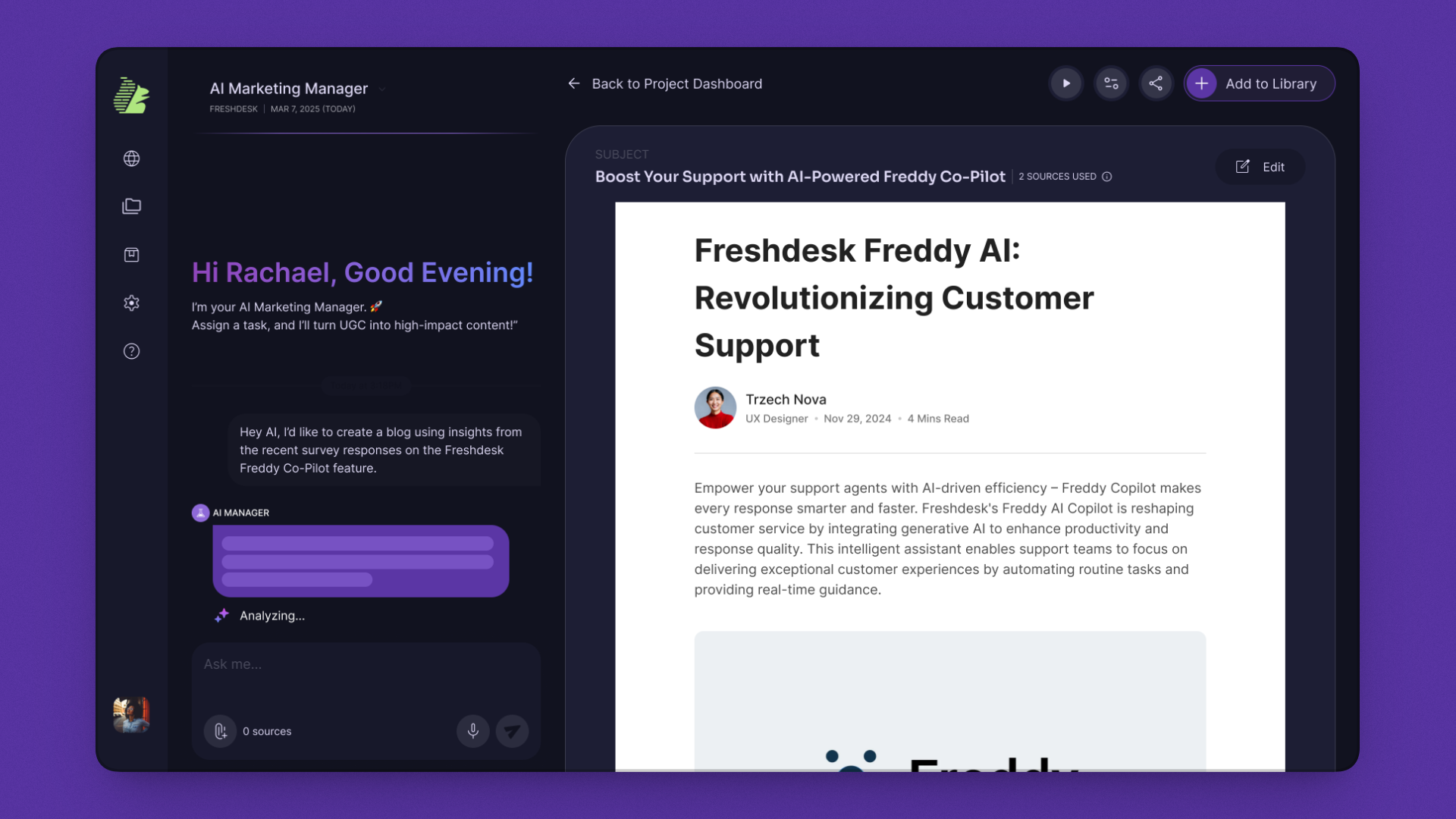
AI Chat Command Centre: The front door of the product.

Conversation Flow
WHY IT MATTERED

SME interviews showed marketers describe their work as delegation, not configuration: “I need someone to take these responses and make a post.” A chat-first model honored that mental model. New users got an instant path to value; returning users saw recent projects.

HOW I SOLVED IT

Designed a single chat surface with five quick-action cards (Video Snippets, Survey Snap, Post Creator, Audio Bites, Blog Creation). The AI handles orchestration no menus, no settings to configure before generating. Zero onboarding required; first-time-to-value measured in seconds.

STRATEGIC VALUE

The chat surface is the scalable front door. New output formats can be added as quick-action cards without redesigning the interface. The interaction model holds regardless of how the AI engine evolves underneath.
Core Feature #2

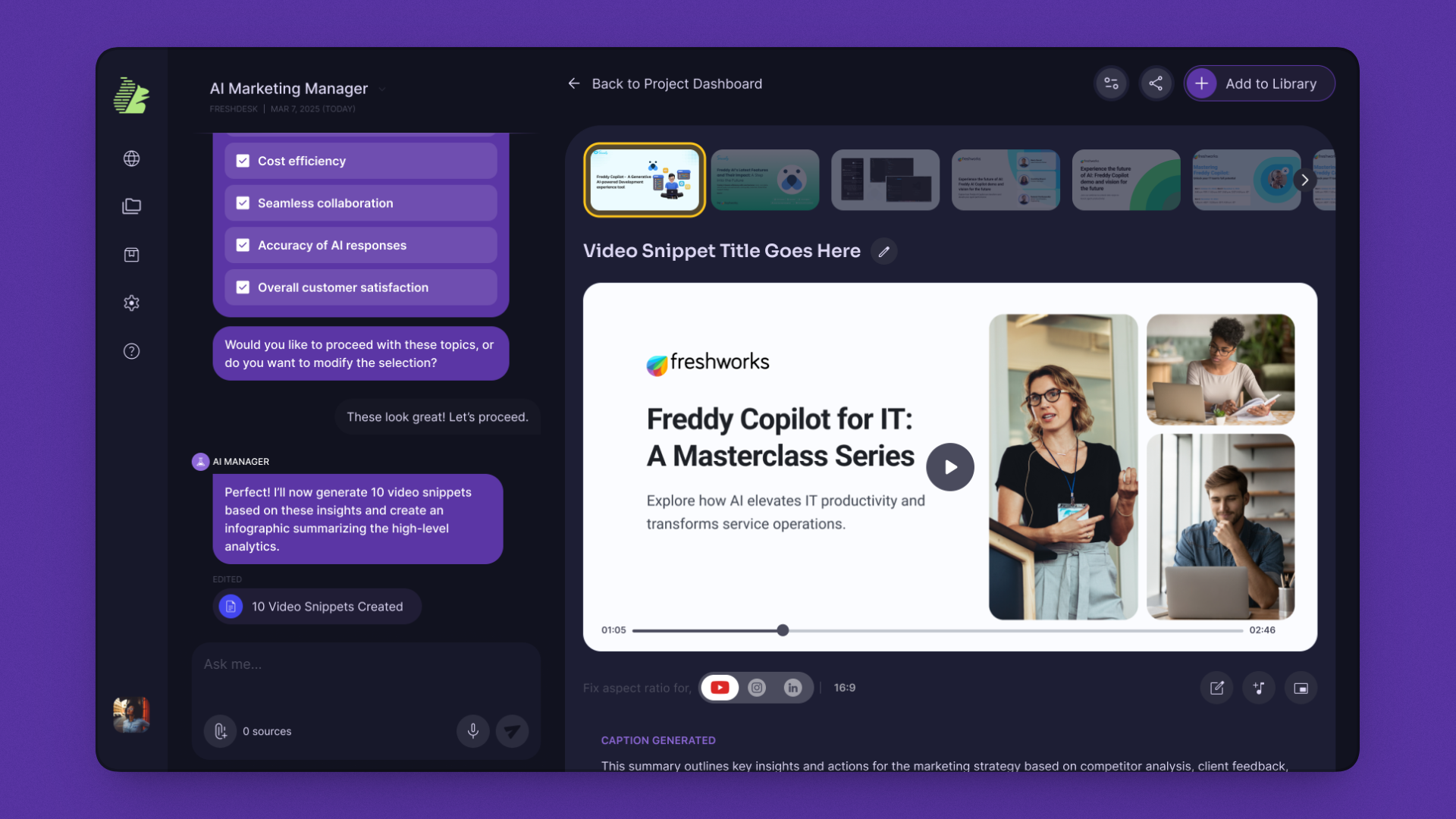
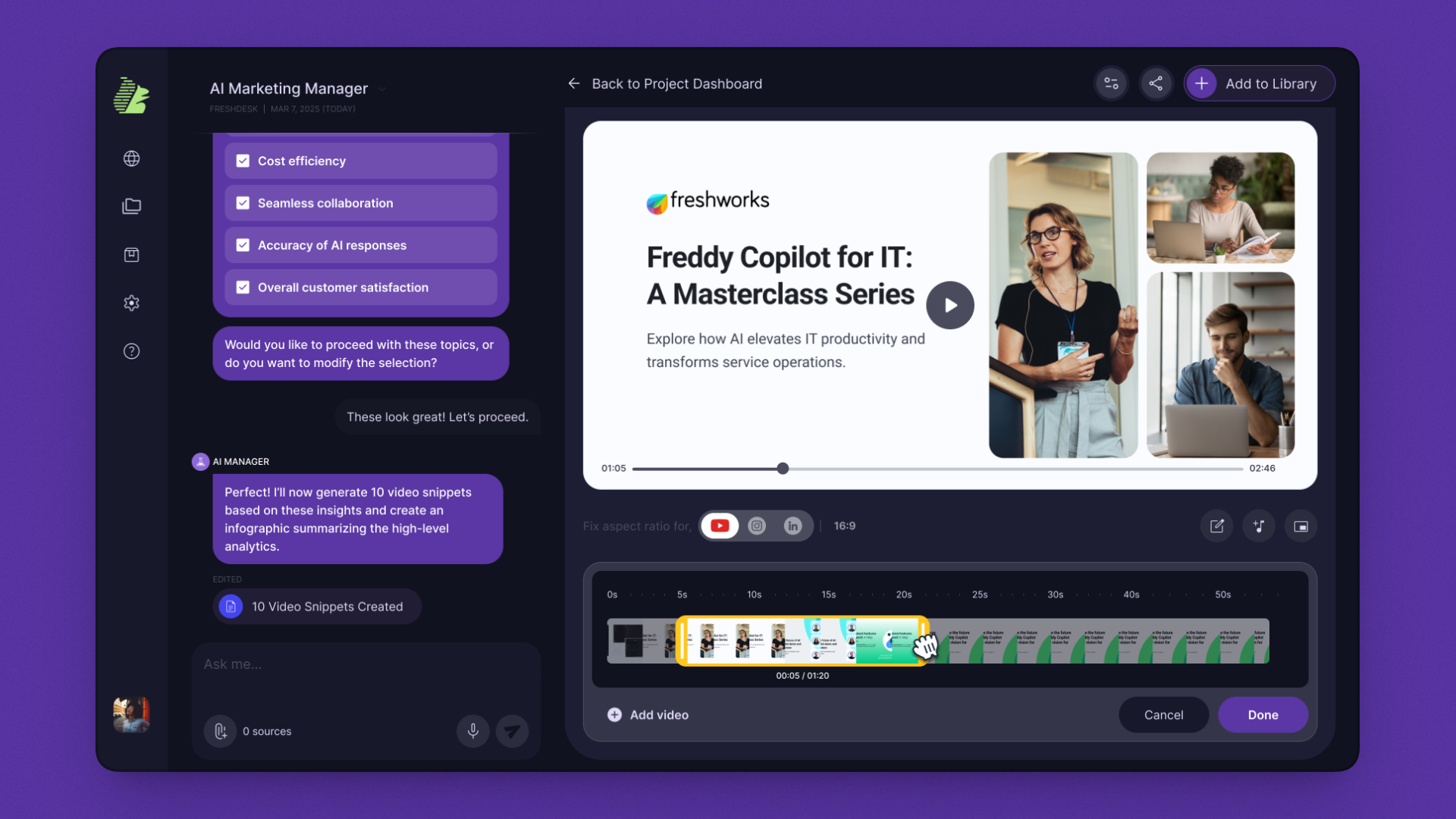
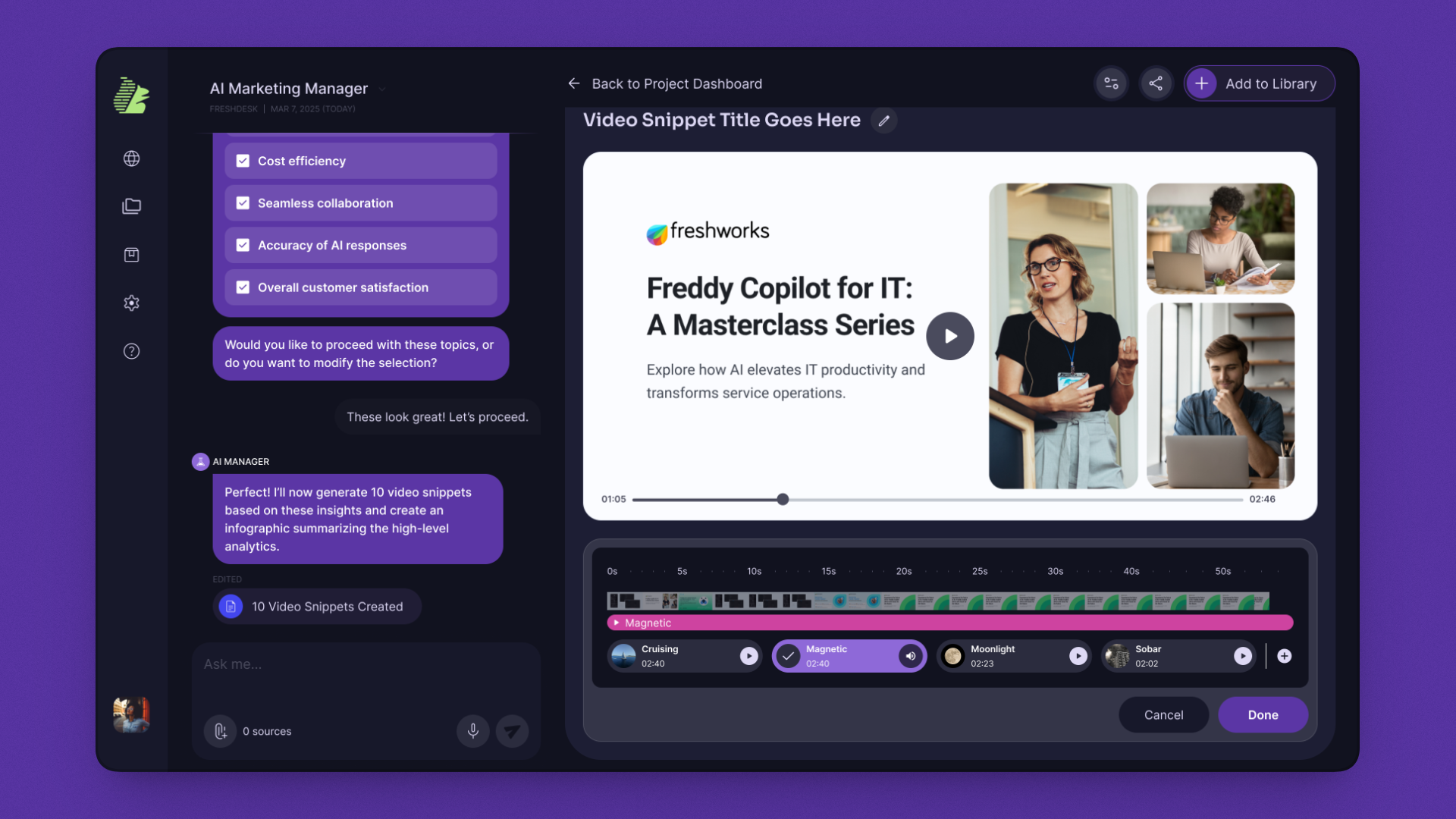
Video Snippets: Generated instantly, editable inline.

Video snippets trim flow
Video snippets trim flow continued
Video snippets add soundtrack flow
WHY IT MATTERED

Video was the most labor-intensive content type in the existing workflow. Premiere, CapCut, hours of clipping. SME interviews flagged inline editing as the most-requested capability. Without it, marketers would still leave the app to finish the work.

HOW I SOLVED IT

Designed a thumbnail strip that shows all 10 generated snippets at once, inline captions for accessibility, and a built-in timeline editor for trim and approve. Platform resize (YouTube, Instagram, LinkedIn) lives in the same panel users never leave the canvas.

STRATEGIC VALUE

Closed the loop on the highest-friction content type. The timeline editor became the pattern for inline editing across every other module trim audio, edit blog, refine post all use the same component vocabulary.
Core Feature #3

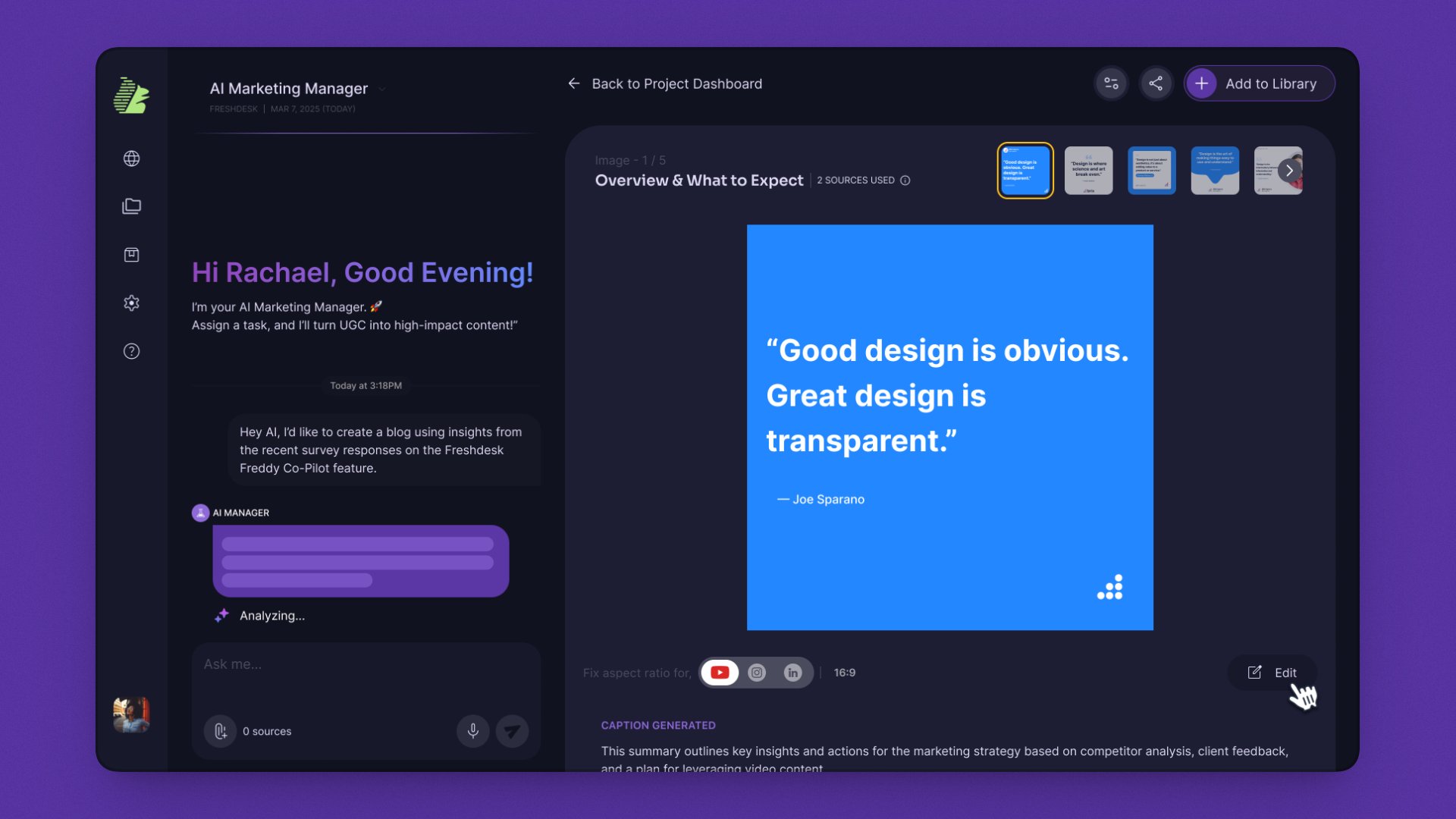
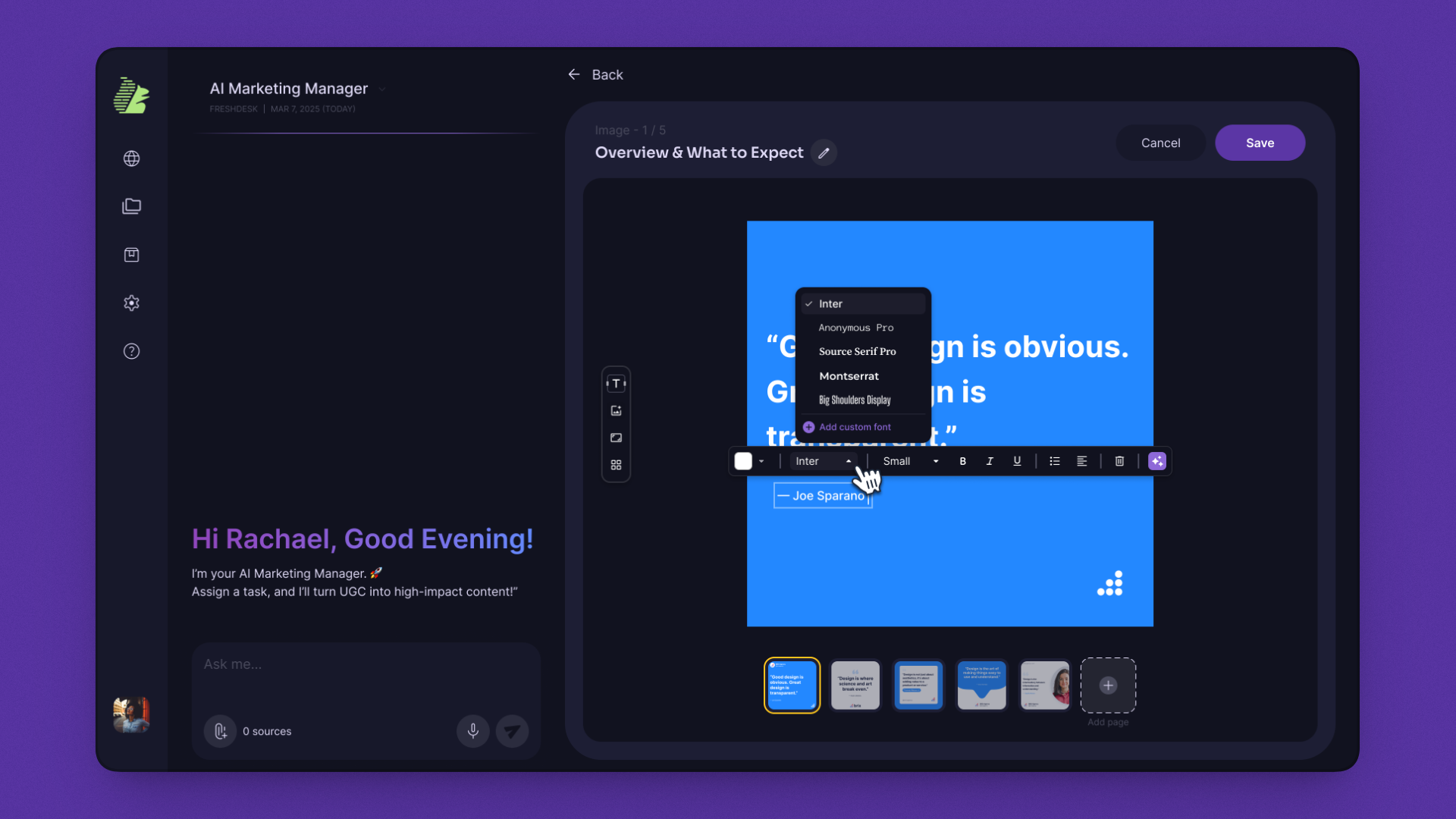
Post Creator: One asset, multiple formats.

Post landing page
Post editor flow
WHY IT MATTERED

Marketers ship the same post across LinkedIn, Instagram, and X three different aspect ratios, three rounds of design work. The PoC sessions confirmed format-switching was the second-biggest time sink after video editing.

HOW I SOLVED IT

Designed brand-consistent generation with one-click aspect-ratio switching. Source attribution baked in for traceability clinicians, sorry, marketers can see exactly which customer quote drove the asset. A slide strip shows all variants; new pages can be added without re-prompting.

STRATEGIC VALUE

The aspect-ratio system became the foundation for any future format expansion ads, reels, carousels all use the same canvas with different output specs. Brand kit lives at the project level, so consistency holds without per-asset configuration.
Core Feature #4

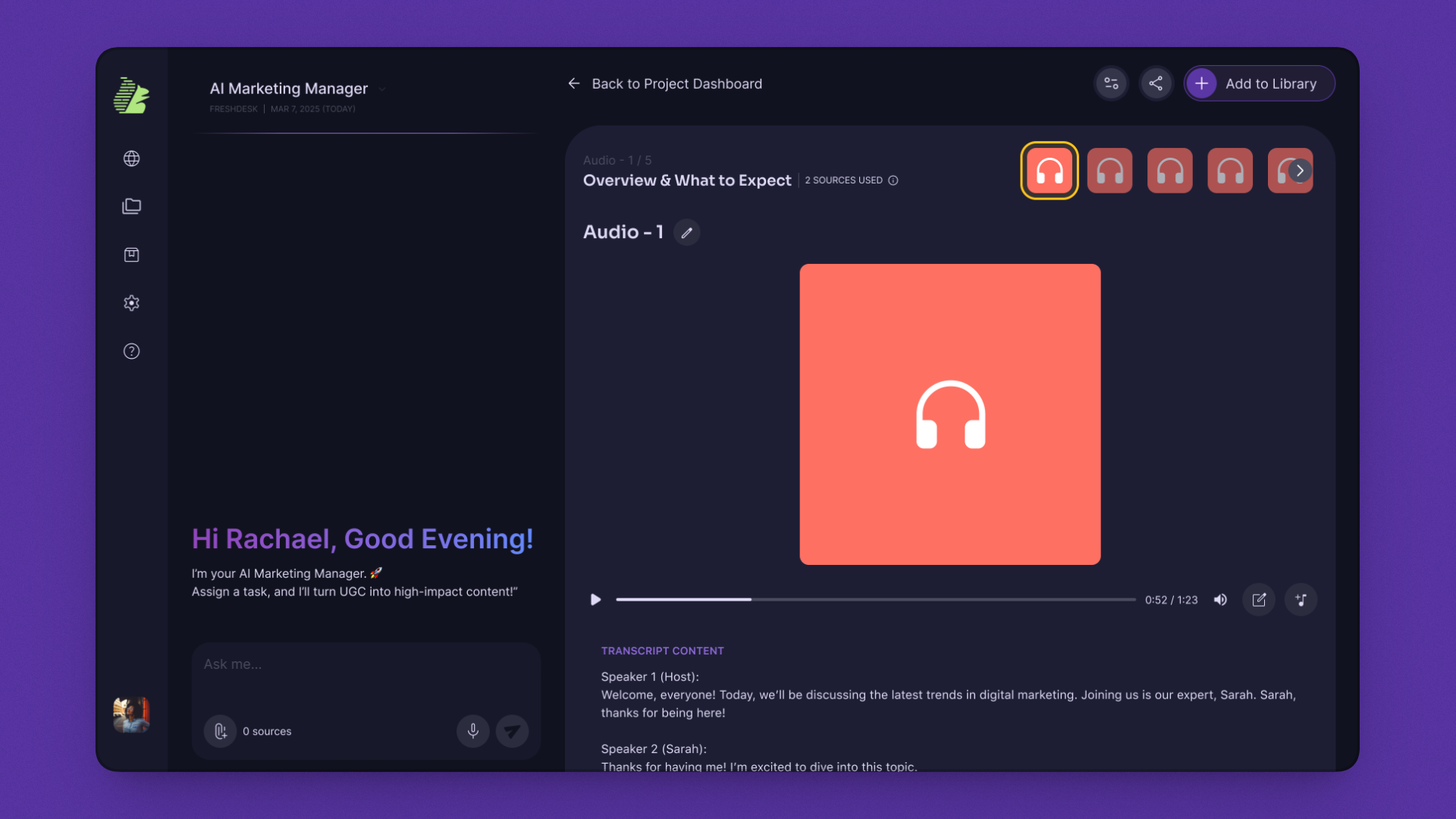
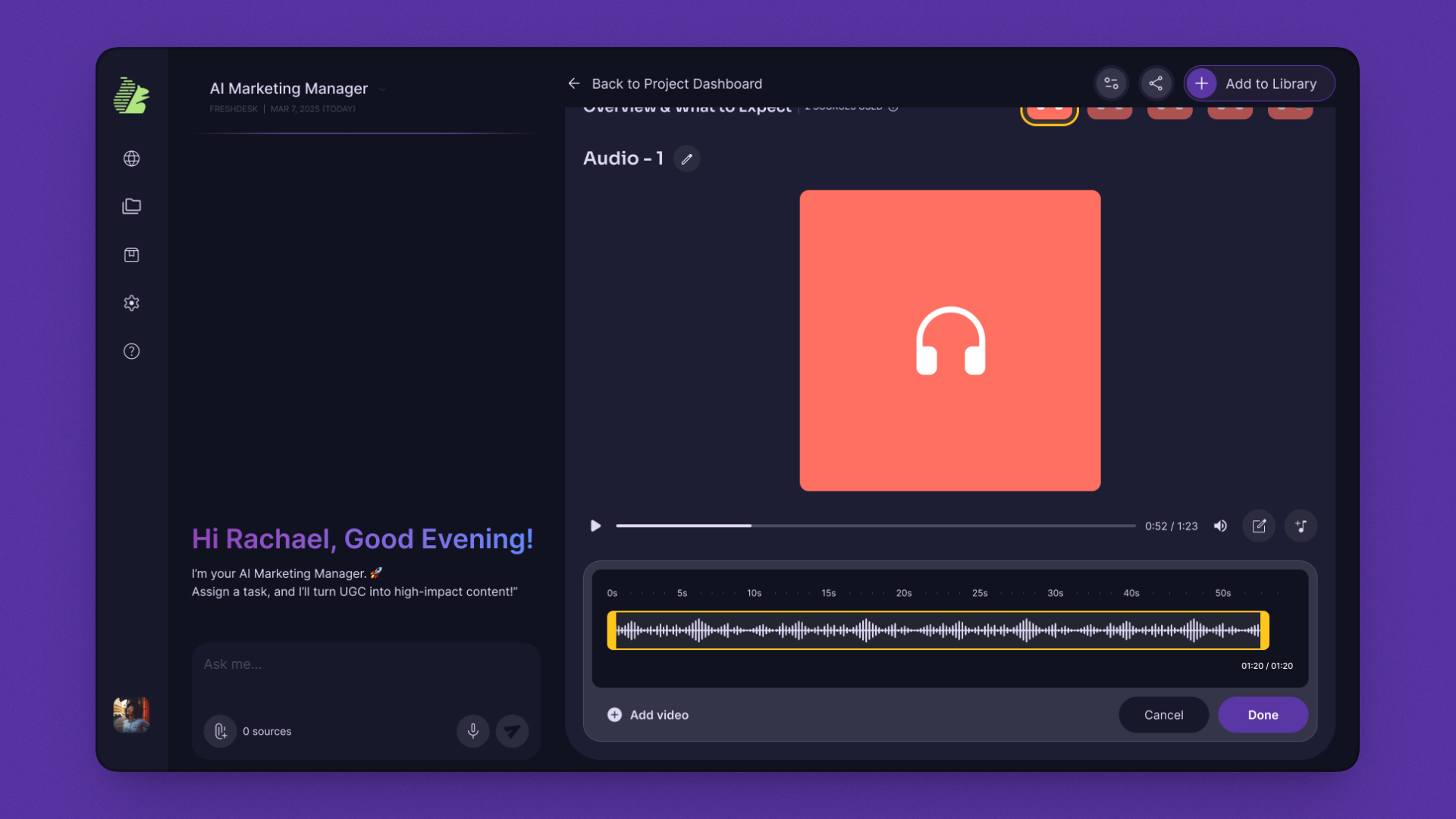
Audio Bites: Voice as a first-class output, not an afterthought.

Audio editor flow
Audio editor flow continued
WHY IT MATTERED

Audio was the most overlooked content type in early concept testing. Marketers requested it for two reasons: shareability (podcast-style clips, testimonial highlights, social audio for Instagram and TikTok) and accessibility (a second surface for the same content). Without an audio module, BuddyHQ would have left an entire category of distribution on the table.

HOW I SOLVED IT

Designed a dual-input system: audio can be extracted from video (pulling spoken moments from testimonials and webinars) or generated from text (TTS with brand voice calibration). One waveform editor, one transcript, one export flow regardless of source. Speaker-labeled transcripts, trim points, multiple variant browsing, and brand audio styling (intro/outro) all live in the same panel.

STRATEGIC VALUE

Audio Bites became cross-module infrastructure, not a standalone format. The same generated bites feed back into the Video Snippets module as background scores closing a loop other tools never close. One generation pass produces a podcast clip, a social audio post, a video soundtrack, and an accessible audio version of a blog. That's compounding value from a single input.

Core Feature #5

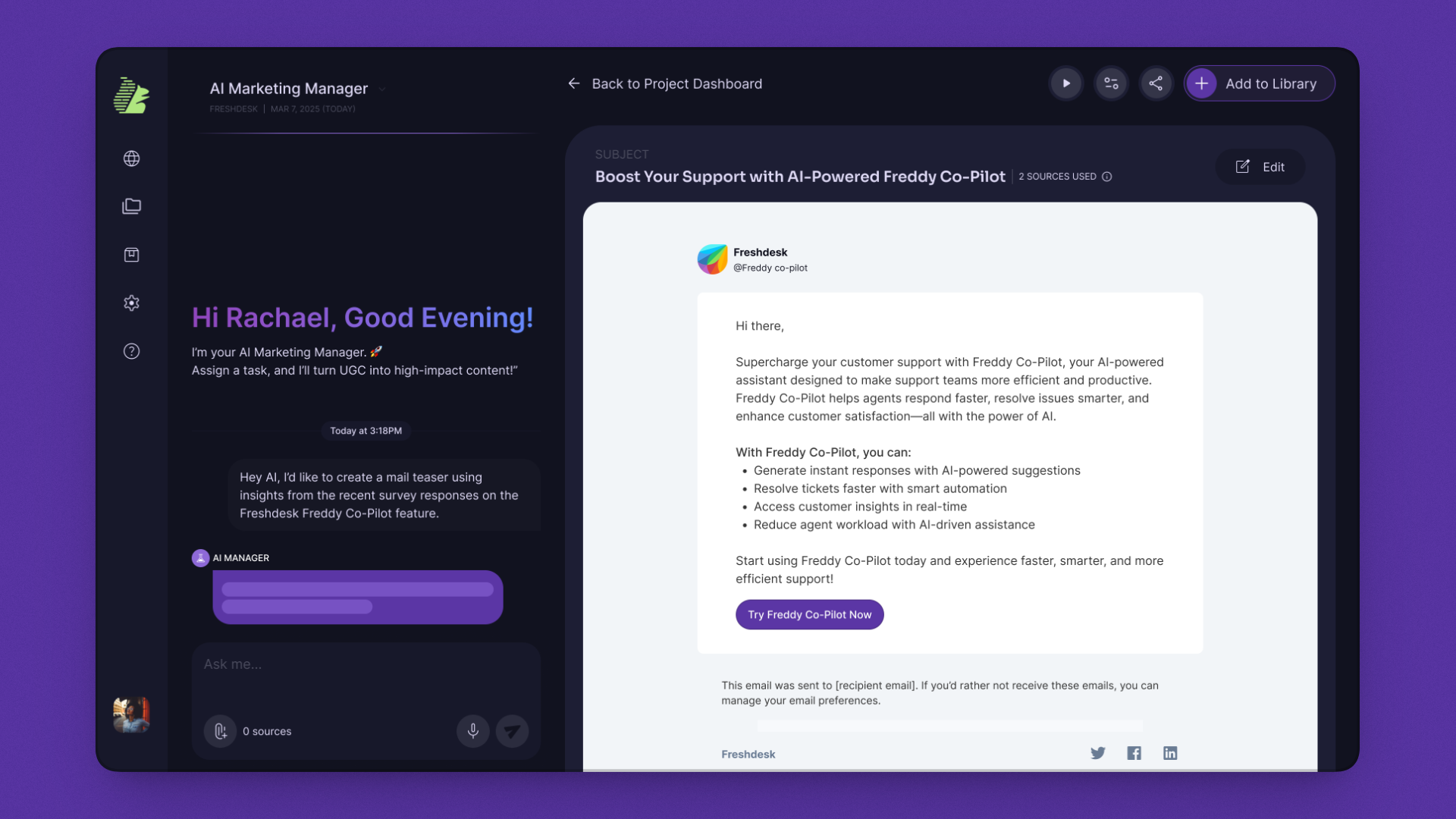
Long-Form Editor: Emails & blogs, end-to-end.

Email template flow
Email template flow continued
WHY IT MATTERED

Generation alone wasn't enough every long-form piece needs editing. If users had to copy text into Google Docs to refine, the value of in-app generation collapsed. The editing experience had to be production-ready, not a fallback.

HOW I SOLVED IT

Designed an inline rich-text editor with contextual toolbar. Font, size, weight, alignment, links all available without leaving the panel. Toolbar placement was the hardest design call in the build: tested fixed-top, sidebar, and contextual-on-selection. Final placement docks away from the canvas and surfaces only on selection.

STRATEGIC VALUE

Establishes BuddyHQ as a production tool, not a draft tool. The editor pattern extends to email composition and any future text-based content type. Users finish the work in BuddyHQ they don't pass it through three other tools to publish.
Core Feature #6

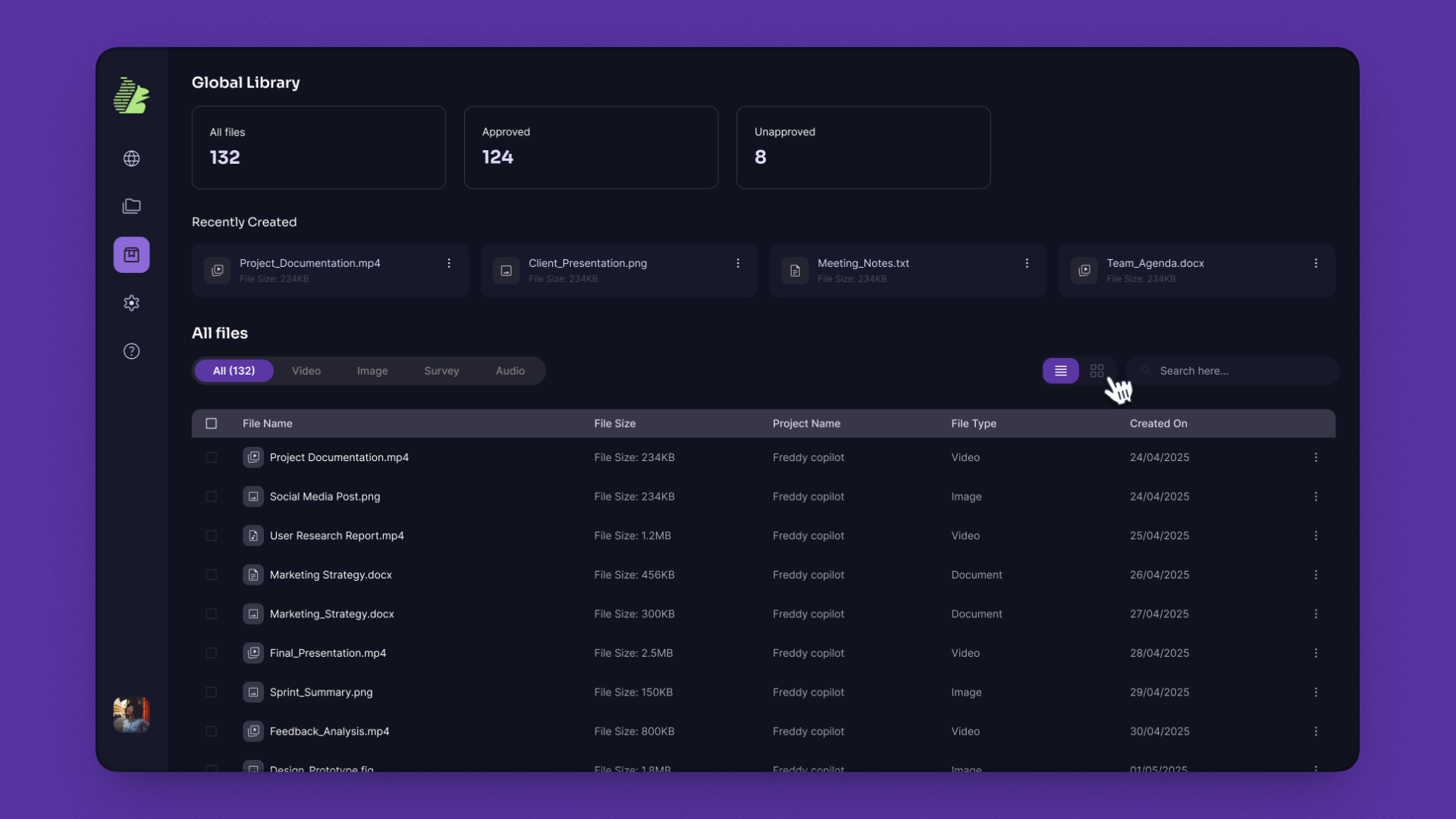
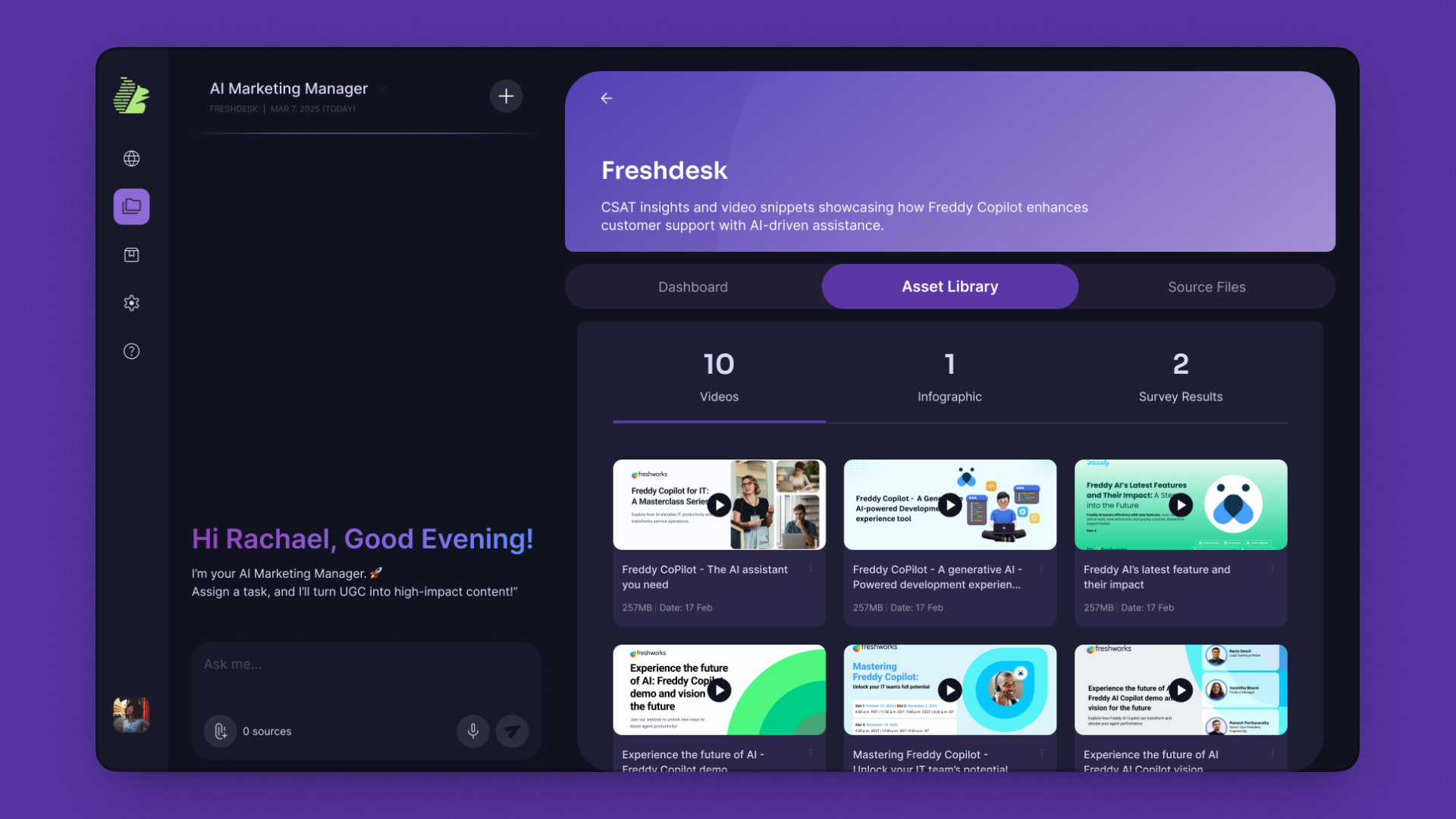
Global Library: The single source of truth.

Global library landing page
Single post landing page asset library
WHY IT MATTERED

SME research surfaced a recurring complaint: “I made a great asset last quarter. I have no idea where it is now.” Without a reuse layer, every piece of content becomes a one-time output. Compounding value never accrues.

HOW I SOLVED IT

Proposed the three-tier hierarchy mid-project, in a team design review. Chat → Project → Library gave content a permanent home. Filter by type (video, post, email, audio), approval status, project. The Library is a single searchable surface across the entire workspace.

STRATEGIC VALUE

The most underestimated feature in the product. The Library is what makes BuddyHQ a platform, not a tool. It scales from one user to an enterprise team without architectural redesign. It's also the foundation for future search, recommendations, and AI-powered reuse suggestions.


Design × Dev

The product is the result of the design–build loop.

I worked closely with engineering across every module. Our goal was to ensure every design decision was technically feasible, scalable, and future-proof especially as we moved toward modular components and partner integrations.

PHASE 01

Design system as infrastructure

Built reusable component patterns from day one. Every module shares the same canvas, the same generation panel, the same editing primitives. Reduced design debt before it could accumulate.

PHASE 02

Iterating on the editor toolbar

The hardest placement call in the product. Three rounds of testing with engineering fixed-top vs sidebar vs contextual landed on contextual-on-selection. The principle: the tool should never compete with the work.

PHASE 03

Co-creating the system

The three-tier content hierarchy emerged in a team design review, not a brief. I proposed it mid-project; engineering scoped feasibility in the same week. The structure came from the problem, not the spec.

My Note

This wasn't handoff. We co-created infrastructure that's still being built on. Every component, every pattern, every decision is something the team can extend confidently, not just use once.


Impact & Outcomes

What was built. What was validated.

BuddyHQ is built and pre-release. The honest story is about what was designed, validated, and shipped. Not paid-customer metrics that don't yet exist. Here's what's real:

6

Core modules shipped end-to-end. Chat Centre, Video Snippets, Post Creator, Audio Bites, Long-Form Editor, Global Library. All built and integrated with the AI engine, ready for pre-release.

7+

Content output formats video snippets, social posts, emails, blogs, audio clips, UGC pages, and platform-specific resizes. All from a single unified interface.

12

Marketing professionals interviewed across SME sessions and PoC validation. Conversational-first interaction model validated with 5/5 teams completing core tasks unaided.

~45s

Average time to first output in PoC testing versus 3–7 days in the existing manual workflow. Stakeholder validation greenlit the next phase of partner-facing rollout.


Takeaways

What I took away.

1

Designing for scale starts on day one.

The three-tier hierarchy and modular component system weren't add-ons they were the foundation. Strategic systems thinking helped us build not just a usable tool, but a platform that supports reusability, customization, and future integrations without redesign.

2

AI products are about trust, not automation.

Mid-project, I had real doubts about the AI premise. Working through that tension made me design for augmentation, not replacement. The output is AI-generated, but every screen is built around a human making the final call.

3

The hardest problems aren't the biggest features.

The editor toolbar placement a small, seemingly tactical decision consumed more debate than any major flow. Friction lives in the details. A toolbar in the wrong position doesn't just annoy users; it makes the whole product feel unpolished.

4

The best structural decisions came from conversations, not planning.

The three-tier hierarchy wasn't in the brief. It emerged from a mid-project design review. That's the kind of decision that only happens if you're paying attention to what's breaking, not just what's been scoped.
5

Collaboration shapes the product.

From shaping the MVP vision with the founder to debugging interaction states with engineering, this project taught me how to align across product, dev, and user needs fast and how the best designs come from co-creation, not handoff.

Next project

Neartail - ChatGPT Apps

Neartail - ChatGPT Apps

2025

Create forms inside ChatGPT and instantly publish them across platforms.

Read more
Route Your Travel

Route Your Travel - Community & AI

2024

From AI-generated travel stories to a connected community of explorers.

Read more